
Part 1: “Post-ODA” Discussions Are Missing a Vital Element: Gender Equality Goals and Analysis
One of the hottest discussions in international circles is: “what comes next for official development assistance?” While the many processes involve different players, questions and proposals, all miss a key piece: explicit engagement with feminist analysis, actors, lessons and solutions.
By Beth Woroniuk, Senior Fellow, Feminist Foreign Policy Collaborative
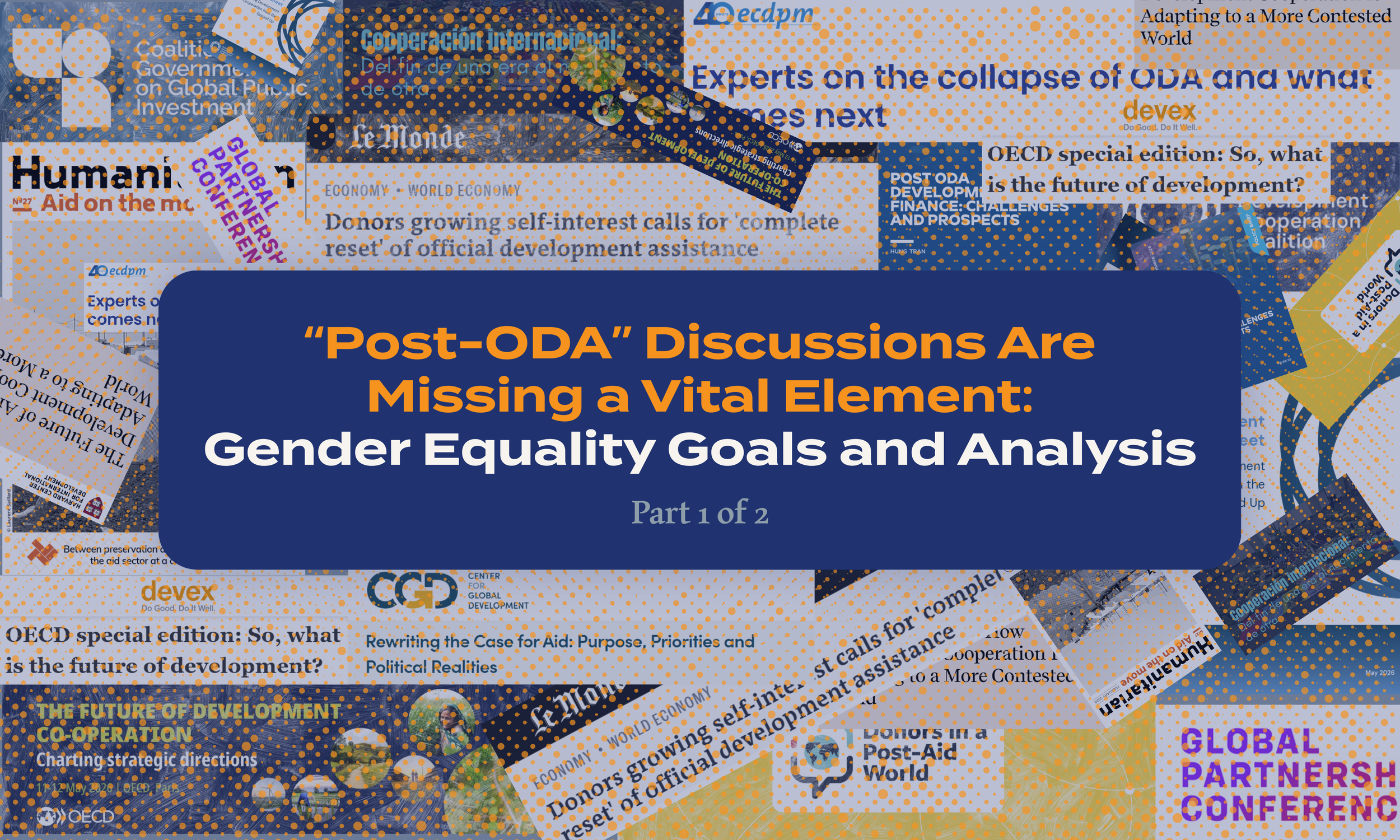
Photo Credit: Feminist Foreign Policy Collaborative
This two-part analysis series examines why this oversight is a fatal flaw and proposes strategic pathways to address gender inequalities. Here’s Part 1. Part 2 can be found here. These analyses are aimed at those already engaged in post-ODA discussions and at feminist funding activists and champions looking for ways to engage in those discussions.
Although it’s much too early to settle on the 2026 word of the year, “rupture” is right up there. Discussions of the global economy, geopolitics, artificial intelligence and international security all center “the new reality” and rapidly changing contexts. This debate is particularly live among those looking at official development assistance (ODA).
Given falling ODA investments (in part, collateral damage of increased defense budgets), an increasingly fractured aid architecture, rejection of the paternalism embodied in the old structures and increased skepticism regarding development investments among Global North politicians and voters, there are multiple current processes to reimagine the development cooperation landscape and infrastructure.
These discussions include explorations of the role of donors in a post-ODA world led by ODI Global, efforts to reform the OECD’s Development Assistance Committee (DAC), a Coalition of Governments on Global Public Investment, the Global Partnerships Conference held in London in May, the World Economic Forum's Global Council on Re-imagining Aid, a coalition launched at the Fourth International Conference on Financing for Development (FFD4) last year to build support for global public investment, the Future of Development Cooperation co-hosted by the African Center for Economic Transformation and the Center for Global Development. There is also the Foro Permanente sobre la Descolonización de la Cooperación Internacional (the Permanent Forum on Decolonizing International Cooperation), based in Latin America and questions on what’s next for the post-USAID sector.
“Glaringly absent from most of these discussions is the recognition of gender equality as a cornerstone of development, in addition to being a goal in and of itself.”
Each of these processes involve different twists on players, questions, processes and proposals. However, generally, the issues under discussion include:
How to move beyond traditional donor-recipient relationships to a “partnership without paternalism” as one author puts it. This theme raises issues related to shared responsibility, collective interest, shifting power and country-led and locally-led development (CLD/LLD).
How to address the challenges of the 21st century — although each process emphasizes different issues — including the climate catastrophe, global inequalities, pandemics and other health threats.
How to build a more coherent and integrated structure that brings multiple mechanisms into sync (e.g., debt relief, ODA, trade regulation, reform of international financial institutions, private investment, remittances).
How to mobilize new resources, often with an emphasis on the private sector. The financing gap to achieve the Sustainable Development Goals (SDGs) is now estimated at 4 trillion USD, far beyond the scope of traditional ODA flows.
How to address the growing trend among OECD members to link ODA to national interests.
How to move beyond the donor-recipient binary recognizing the diversities of economies and geopolitical shifts, as evidenced by the emergence of “non-traditional donors,” inequalities within “traditional donors” and countries “graduating” from the OECD DAC ODA-eligibility list.
Glaringly absent from most of these discussions is the recognition of gender equality as a cornerstone of development, in addition to being a goal in and of itself. Too often, gender equality is treated as a niche issue and marginal to the “real conversation.” In fact, many stress the importance of narrowing the range of issues addressed. Is this, in fact, an oblique critique that sees issues like democracy, gender equality and human rights as tangential to the predominant priority of economic infrastructure?
“As politicians and pundits talk about the rupture, gender justice activists are living it.”
Why is it critical to rectify this omission? Do we really have to make the case in 2026 that equality for all belongs in discussions about the future of development cooperation? Unfortunately, it seems we do. So here are a few of the reasons why this glaring gap needs to be addressed.
It’s the right thing to do: The gender inequalities that continue to exist in all countries and parts of the world are well documented. Failure to ensure the rights and dignity of women and girls in all their diversity when considering proposals to rebuild the global financial architecture is manifestly unjust.
There are multiple normative and legally-binding international commitments to gender equality and the rights of women and girls: States the world over have made multiple commitments to the rights of women and girls. From the Beijing Declaration and Platform for Action to the Convention on the Elimination of Discrimination Against Women (CEDAW) to the Pact for the Future, there are long-standing, ongoing, regional, global and national commitments and global norms supporting gender equality. Given recent attacks on these rights, governments that support equality for all have a responsibility — and in some instances, a legal obligation — to address these issues in post-ODA discussions.
Traditional ODA donors have long-standing commitments to gender equality in development cooperation and humanitarian assistance. In 2024, members of the OECD DAC adopted updated guidance on gender equality. This included implementing “development, humanitarian and peacebuilding programmes and projects aimed to accelerate gender equality,” and striving to increase financing for these initiatives. Two years later, the reasons for adopting this guidance remain valid and even more urgent. Now is not the moment to abandon these commitments.
States — both of the Global South and Global North — have made commitments to bring a gender perspective and promote gender-responsive solutions across the financing for development agenda, most recently at the 2025 Fourth International Conference on Financing for Development (FFD4) (see below).
We reaffirm the imperative of achieving gender equality and the empowerment of all women and girls. We will ensure their full and equal enjoyment of all their human rights and fundamental freedoms. Gender equality and the empowerment of all women and girls bring proven economic benefits and have the potential to contribute to financing for development. We commit to mainstream a gender perspective and promote gender-responsive solutions across the financing for development agenda. We recognize that the feminization of poverty persists, and the eradication of poverty in all its forms and dimensions, including extreme poverty, is an indispensable requirement for women’s economic empowerment and sustainable development. We will increase investment in the care economy and recognize, value and equitably redistribute the disproportionate share of unpaid care and domestic work done by women. We reaffirm our commitment to eliminate gender-based violence.
— FFD4 Outcome Document: Sevilla Commitment
There is more and more evidence of the strong links between gender equality and economic development. The barriers to women’s economic participation, including discriminatory laws, social norms, unequal access to finance and digital spaces and inequitable distribution of unpaid care responsibilities, all restrict and hamper the return on development investments.
Progress on gender equality is necessary for the achievement of other development goals. The efforts to implement the SDGs clearly demonstrate that narrowing gender gaps is a critical force multiplier in achieving other development goals. For example, increasing women’s access to decent work and regular incomes contributes to poverty reduction and supports better education, health and nutrition outcomes. Research from the Georgetown Institute for Women, Peace and Security highlights the strong correlation between women’s status and a country’s level of democracy.
In this moment, failing to address the rights of women and LGBTQIA+ people in building new global financial structures supports anti-rights/anti-gender actors and narratives. There is an organized and well-funded effort to roll-back women’s rights that also includes attacks on LGBTQIA+ people. The implications of failing to support the movements who lead the resistance to these anti-rights actors are devastating. Anti-gender actors share agendas with climate deniers, anti-science activists and anti-immigration mobilizers, all working to undermine democratic institutions.
ODA has played an important role in funding feminist and queer movements. ODA cuts mean hardship for hundreds of organizations leading grassroots work strengthening and advancing democracy, health and climate justice with transformative and transnational impact. Alternative ways of supporting these movements belong in these discussions. This is a critical moment in the fight for gender justice. Initiatives and discussions that are silent on these issues implicitly reinforce and give strength to the anti-rights/anti-gender actors.
Huge gaps remain in gender equality financing. UN Women has estimated that “developing countries” face a 420 billion USD annual shortfall in the funding needed to achieve gender equality. In 2022-2023, bilateral aid supporting women’s rights organizations and movements sat at 0.4 per cent of bilateral aid to conflict-affected contexts. This is below the minimum allocation of 1 per cent recommended by the United Nations. The post-ODA discussions are an opportunity to build in solutions to these gaps.
Feminist activists and analysts have much to contribute to the discussion on what sort of global financial architecture can best serve all people. There are multiple critiques of ODA and existing institutional mechanisms, as well as proposals on how to move forward. For example, structuring debt-relief to strengthen gender-transformative healthcare infrastructure and expand access to sexual and reproductive health services and grounding discussions of tax reform in the principles of human rights, equality and justice and placing care work and environmental sustainability at the center of economic policy.
As politicians and pundits talk about the rupture, gender justice activists are living it. UN Women recently surveyed women’s organizations operating in crisis settings. Almost nine in 10 said they can no longer meet current levels of need while two in five organizations surveyed expect to shut down, temporarily or permanently, within the next year. Multiple indexes continually document gender gaps. These inequalities affect economies, families, communities and even national security, and they belong in post-ODA discussions.
Further Reading
Analysis: Part 2 — Building a Better ”Post-ODA World” – Pathways to Incorporate Gender Equality
Panel Summary: Feminist Funding in a Post-ODA Era: Reimagining Aid’s Architecture
Policy Recommendations: Preliminary Report — Financing for Gender Equality at Upcoming International Conferences: Exploring Options
Opinion: To make the business case for gender equality, time for a fresh framing in Devex
Analysis: Feminist Foreign Policy and Development Finance for Gender Equality: Momentum Under Threat
Primary Author and Contact
Beth Woroniuk, Senior Fellow, Feminist Foreign Policy Collaborative
For any inquiries, please contact beth@ffpcollaborative.org or general@ffpcollaborative.org.
Acknowledgements
The author thanks Spogmay Ahmed (Feminist Foreign Policy Collaborative), Rachel Jacobson (Alliance for Feminist Movements), Jill Montilla (Equipop) and Lilly Nicholls for their inputs and suggestions.
Disclaimer
The views and opinions expressed by members of the Visiting Fellows Program are solely their own and do not necessarily reflect those of the Feminist Foreign Policy Collaborative.