
Spain’s Foreign Policy Isn’t Just Brave, It’s Feminist
By Spogmay Ahmed, Deputy Director, Feminist Foreign Policy Collaborative
Originally published in Interruptrr on June 2, 2026
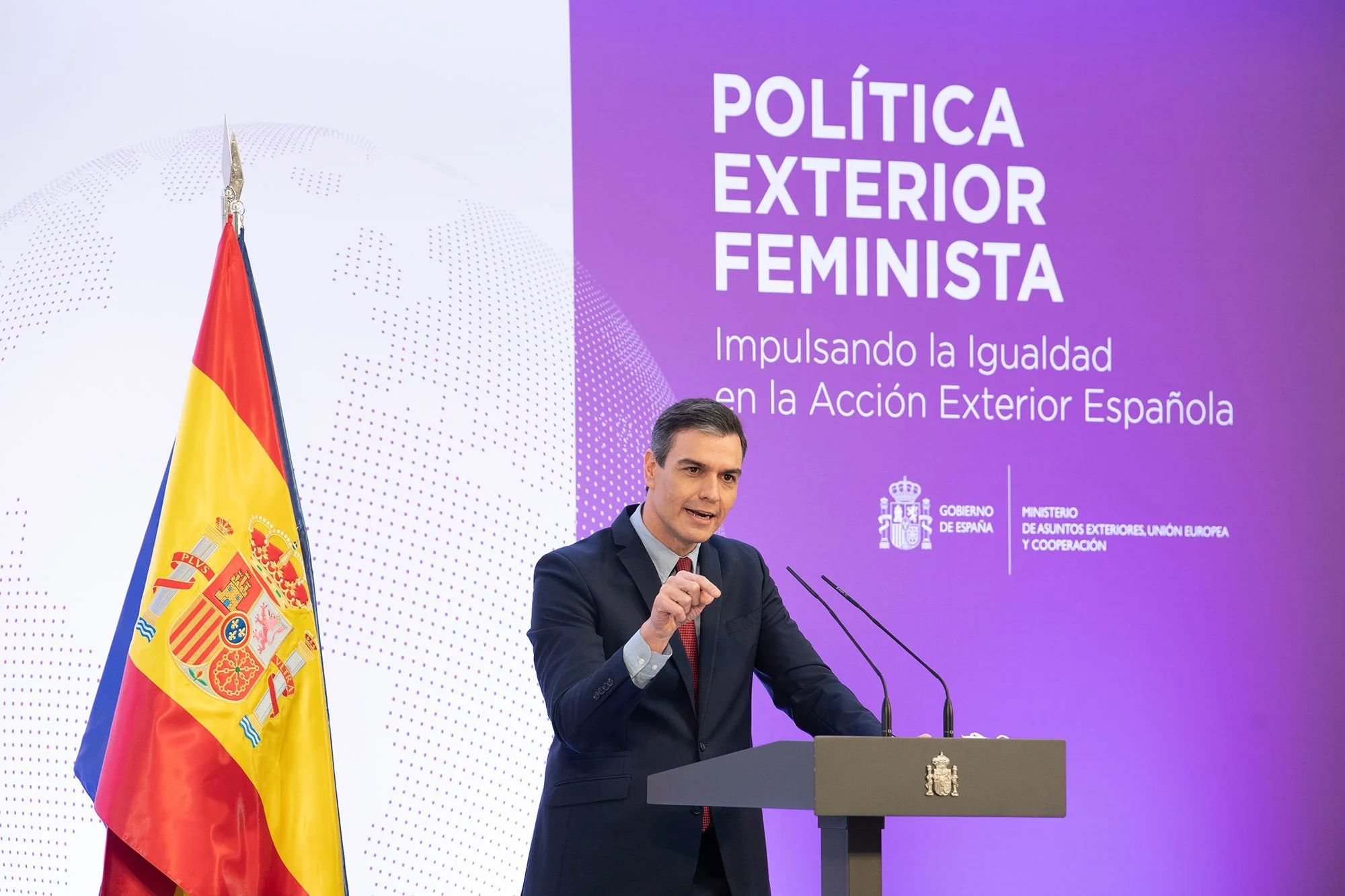
Photo Credit: Pool Moncloa/Borja Puig de la Bellacasa
Prime Minister Pedro Sánchez of Spain has made countless headlines over the past few months. From his relentless and consistent condemnations of President Trump and Israeli Prime Minister Benjamin Netanyahu to his ascent as a convener of global progressives, Sánchez has stood out for his defense of democracy, multilateralism and the rules-based international order—offering leadership in a seemingly hopeless era for global cooperation and diplomacy.
Missing from the headlines and political analyses, however, is coverage of Spain’s lesser known, ambitious agenda undergirding its actions on the international stage: its feminist foreign policy.
Since the world’s first feminist foreign policy was launched by Sweden in 2014, 15 more governments (and counting) have formally adopted the agenda, committing to advance gender equality and human rights in their foreign policy, diplomacy and multilateral engagement. Several of these governments have published feminist foreign policy guidelines, appointed ambassadors to advance the agenda and leveraged their commitments to deepen bilateral relationships. Feminist foreign policy has taken stage at the United Nations and regional bodies, and captured the attention of civil society organizations and feminist movements worldwide.
Feminist foreign policy, for many, represents a way of doing things differently—an alternative to traditional foreign policies that prioritize military prowess and “might makes right” ideology at the expense of human safety. But for others, feminist foreign policy raises eyebrows; activists have questioned the feasibility of a state to truly be “feminist,” and whether the adoption of a flashy title prioritizes a political brand over transformative change. Spain’s feminist foreign policy, however, might offer skeptics some reprieve.
Spain committed to a feminist foreign policy in July 2020, and has since published official guidelines, a follow-up action plan and reiterated its commitment in its most recent foreign policy strategy. Most often, feminist foreign policies are platformed by ambassadors or foreign ministers, but in Spain’s case, Sánchez himself has invoked the commitment—signifying the rare elevation of the commonly-overlooked agenda by a state leader.
Today, Spain will host the 5th Ministerial Conference on Feminist Foreign Policy in Madrid. Bringing together fellow governments, researchers, philanthropists and activists, this two-day conference comes at a time when efforts to advance gender equality are under attack and on the brink of collapse. The conference’s subtitle, “Building Peace and Democracy,” speaks to Sánchez’s ongoing campaign for rights, justice and “no to war.”
In an era of intense rollbacks on gender equality and multiple rescindments of feminist foreign policies, Spain’s commitment to the agenda has deepened, expanded and withstood the tests of time. This International Women’s Day, Sánchez declared, “...we believe that feminism is a cross-cutting, not sectoral, policy that must permeate each and every one of the policies we launch and implement from the Government of Spain.”
An oft-considered “middle power,” Spain has stood out on the world stage through its advocacy for human rights, international law and global peace—which advocates, researchers and policy experts recognize as core elements of feminist foreign policy. For example, Sánchez distinguished himself from other European allies with his early and consistent opposition to the US-Israel war on Iran. In line with Spain’s feminist foreign policy, he decried assumptions that the war would result in the liberation of the Iranian people. He declared,
“Therefore, I will say it loud and clear: if we truly believe—and I believe we do—if we truly believe in the freedom of Iranian women, the response cannot be more violence; it must be more diplomacy, more support for those fighting from within, and, of course, more international law.”
Also, Spain emerged as one of the most vocal critics of the Government of Israel, recently calling for an end to EU-Israel relations, and was the only member of NATO to refuse the increased defense spending target of 5 percent of GDP, citing concerns for social investment and affirming that its defense needs were adequately met.
Furthermore, at a time when most countries are cutting back official development assistance, Spain has increased its investment by an impressive 13 percent, reaching its highest levels in 15 years. This January, Spain even launched its Feminist Cooperation Strategy, which “addresses structural gender inequalities from an intersectional approach, transforming the power structures that perpetuate them” in its development action and assistance. And while many European counterparts tighten their borders, Spain recently took steps to legalize 500,000 undocumented migrants, an effort largely led by grassroots women organizers employed as caregivers and domestic workers. Activists have pointed out, however, that Spain’s embrace of migrants is warmer towards Latin Americans than Africans, who face greater roadblocks in route to the country and upon arrival.
As feminist foreign policies have expanded in scope and ambition, so too have questions about their coherence. Are feminist principles being applied across all areas of foreign policy? While many governments have fallen short of advocates’ litmus test for consistency, Spain might just have a chance. But it’s not guaranteed; without a reckoning of its colonial history and principled management of Sánchez’s domestic troubles—including proximity to corruption-laden associates and party members facing sexual harassment allegations—Spain could easily veer off course. However, against the tide of right-wing victories and impulsive state leaders, Spain is offering hope to those who invested in international norms, laws and principles, and now want to see them implemented.
The 5th Ministerial Conference on Feminist Foreign Policy provides Spain yet another opportunity to exercise leadership on the global stage. This time, to demonstrate how feminism can be a powerful force for the protection of people, peace and the planet. Spain aims to build on the declaration spearheaded by France at last year’s Ministerial Conference, in which 31 countries committed to advancing feminist or gender-transformative foreign policies, among other critical issues like abortion and climate change.
As state leaders figure out how to manage the so-called “rupture” of the current world order, the 5th Ministerial Conference might be Sánchez’s chance to position feminist foreign policy as a meaningful, credible approach to international relations. It remains to be seen whether he will join Foreign Minister José Manuel Albares in presiding over the conference, and how Spain will leverage the opportunity to influence broader geopolitical matters, but for now, it seems hosting duties have fallen to the right hands.