
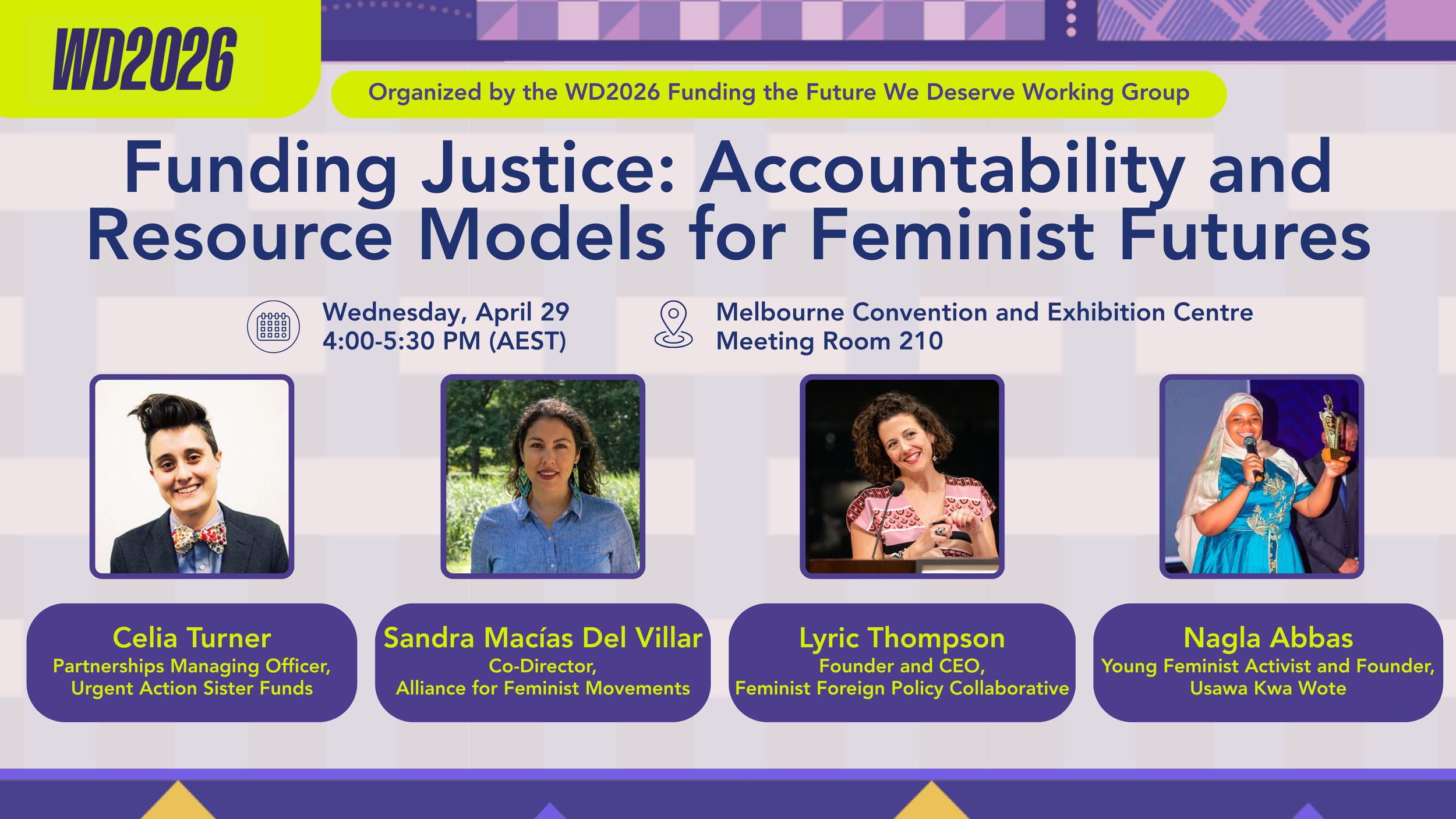
About the Event
Organized by the official WD2026 Resourcing Working Group, this urgent session focused on actionable change in funding feminist movements. Through lightning talks and interactive discussions, speakers explored sustainable models and accountability mechanisms and demystified funding narratives, emphasized accessible and effective solutions, including the roles of philanthropy and official development assistance (ODA). Participants unpacked examples of how movements are holding states accountable while building resilient infrastructures centered on feminist values. Participants left equipped with concrete ideas and tools to enhance their resource mobilization efforts for a better future.
Speakers
Please find speaker biographies below.
Celia Turner, Partnerships Managing Officer, Urgent Action Sister Funds
Sandra Macias Del Villar, Co-Director, Alliance for Feminist Movements
Lyric Thompson, Founder and CEO, Feminist Foreign Policy Collaborative
Nagla Abbas, Young feminist activist and Founder, Usawa Kwa Wote
Speaker Highlights
Please find below the transcript of a “'lightning talk” between Lyric Thompson, Founder and CEO of the Feminist Foreign Policy Collaborative, and H.E. Mr. Ernesto Cespesdes Oropeza, Ambassador of Mexico to Australia.
Lyric Thompson, Founder and CEO, Feminist Foreign Policy Collaborative
Your Excellency, Mr. Ernesto Cespesdes Oropeza, it's an honor to be sharing this lightning talk with you. We have a lot of things to do in our 10 minutes, first of which is, give you the trends — which is mostly the bad news — then to tell you the good news that you probably don't know about and what we can do to support this momentum.
It's my pleasure to sit with Beth Woroniuk, our Senior Fellow on financing for gender equality at the Feminist Foreign Policy Collaborative, who is really the expert that you should talk to about the trends. She wrote a paper that I'm going to talk about briefly in setting the table here. Of course, if you've been to the plenary and if you've been paying attention lately, you know that overall, the trends for government investment in official development assistance broadly — and gender equality, in particular — are poor. We've seen our largest contraction on record of 23 per cent in the last year that we have data available. Overall support for women's rights organizations is falling as well. We know that, however, the paper that Beth wrote last and released at the last Ministerial Conference on Feminist Foreign Policies in Paris last October, shows that there is some good news within that, which is that the announcement of feminist foreign and development policies does coincide with increased spend on gender equality and increased support for women's rights organizations at the time of the policy’s announcement.
But even these governments are not protected. They are at the risk of the same political whims and wins that we are all experiencing. However, some of them are standing strong, and we're going to hear from one of those governments today. While Mexico is not an OECD Development Assistance Committee donor country — which is what the research that I was quoting was based on — Mexico does fund regionally and is also doing really innovative work domestically, through a mechanism that you are going to tell us about, like Annexo Trece which I've seen referred to as “transformative Annex 13,” which just makes my policy wonk brain go wild.
Tell us a little bit about what Mexico is doing as a feminist foreign policy country, including domestically resourcing gender equality and the women's rights movement.
H.E. Mr. Ernesto Cespesdes Oropeza, Ambassador of Mexico to Australia
Thank you very much for inviting me. I’m far from an expert, but certainly I've been a public official for many years at the Ministry of Foreign Affairs [of the Government of Mexico], and I have dealt with gender issues for quite a long time.
First of all, when it comes to a country like Mexico, there are quite a few contrasts. Yes, we are a member of the OECD, but we are not a member of DAC. We are the 15th economy in the world, and yet, the share of the GDP that we actually spend towards our public budget, is way lower than an average developed OECD member. In that regard, we are very constrained when it comes to public spending.
And yet, in the past two federal administrations, gender issues have been elevated to a level where they were not before. For example, the parity concept was elevated into constitutional rank, and that means that at least half of the 500 members of the lower chamber of Mexican Congress are women, and they pass the budget.
You were talking about Annex 13 of the budget in Mexico earlier. Annex 13 mandates that around 10 per cent of [Mexico’s] public budget is allocated in a cross-cutting manner among the federal institutions to spend with gender equality in mind. Gender equality in a country that is actually a big one — our population is 130 million — a country with a little less than half of its population in poverty, under poverty level and some millions under extreme poverty levels, so it is really a concept to deal with. But we are making the federal administration to mind gender as a pivotal concept. It's really, really advancing from what it used to be.
Lyric Thompson, Founder and CEO, Feminist Foreign Policy Collaborative
Yes, it's been so exciting to follow Mexico along this journey. It's been six years since Mexico announced its feminist foreign policy, and I just want to underline the point that there are impacts of these things. Mexico achieved parity in the legislature, the women pass the budget, and then you have a budget mechanism that invests not only in gender equality but also in other marginalized groups through this policy mechanism.
I want to turn now to talk a little bit about how you have tried to marshal resources for gender equality on the global stage through your feminist foreign policy. Mexico was the host of the Third Ministerial Conference on Feminist Foreign Policy in 2024, and you were the first you were the first of the hosts to try to make a political outcome and to link feminist foreign policy — which is often translated as “women-y foreign policy” — to your international agenda, including forums like the Financing for Development Conference. So tell us a little bit about what Mexico's goals were there, and what you feel like your outcomes were that set the stage for Spain.
H.E. Mr. Ernesto Cespesdes Oropeza, Ambassador of Mexico to Australia
First of all, our foreign policy has been recently labeled feminist, but as opposed to countries that have left the concept that they have taken off the label feminists in their foreign policies because they’ve taken care of the issue already. In Mexico, I think it was necessary to label that foreign policy as feminist because it has been for a long time and again, because of the numbers, because of our demographics, because of our social standing, I wonder why it wasn't labeled sooner.
Secondly, that translates generally and always in our standards in international forums like you mentioned, the Third Ministerial Conference for Feminist Foreign Policy. And yes, we introduced certain concepts there, along with UN Women and other countries that led to initiatives on care, that led to initiatives that were taken later to Seville at the Financing for Development Conference. So that's the path we have traced in order to keep and to help the multilateral system to survive this series of backlashes that we are unfortunately witnessing.
Lyric Thompson, Founder and CEO, Feminist Foreign Policy Collaborative
Muchísimas gracias for your leadership and for your interventions today. It's been a real pleasure to watch that leadership and to watch Mexico’s effort to link with some of these harder foreign policy and multilateral forums, which we don't always see. Often the gender portion of a Ministry is marginalized, doesn't have resources, etc. Mexico really was the first to change that at the Third Ministerial.
So you mentioned Spain. Spain hosted the Financing for Development Conference last June, and they will be hosting the Fifth Ministerial Conference on Feminist Foreign Policy this June 2nd and 3rd. I just want to call out Spain as another feminist foreign policy country who has not only tried to hold the line on funding but has actually increased it. Only seven countries increased their development assistance in the last year that we have data available — Spain is really at the leading the pack.
They used their leadership of the Financing for Development Conference last summer to try to crowd in commitments, including for mechanisms on gender equality. And they have demonstrated that they intend this to be a headline and an outcome of the Ministerial Conference this June.
So my call to action to you, and what I hope we can talk about in the next tables, is how you are pushing on your governments to show up to Spain and make financial commitments. Spain is opening this as a pledging opportunity, and my organization will be launching an accountability mechanism that will be tracing all of those commitments that were made in France last year that will be made in Madrid, and we need your help.
It is possible to continue to hold the line and to increase spending. These are the governments that are doing it, and we thank you so much for your leadership.
Biographies
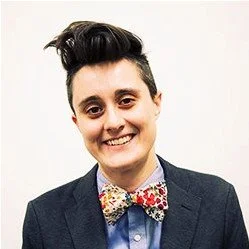
Celia Turner |
Partnerships Managing Officer, Urgent Action Sister Funds
Celia Turner (they/hem) is a feminist philanthropic advocate for gender, racial and economic justice organizations and movements. As the Partnerships Managing Officer for the Urgent Action Sister Funds, Celia raises the visibility of feminist rapid response and nurtures partnerships for the Sister Funds’ collective support of women and LGBTQI+ human rights defenders across the world. They previously lead and managed institutional and philanthropic partnerships at the Astrea Lesbian Foundation for Justice. Learn mroe about Celia’s background and experience here.
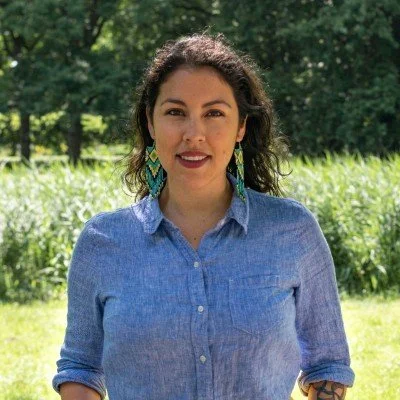
Sandra Macias Del Villar | Co-Director, Alliance for Feminist Movements
Sandra Macías del Villar (she/her) is a passionate intersectional Latinx feminist with extensive experience working in the human rights philanthropic sector. She has specialized in feminist grantmaking with women’s funds as well as resourcing social justice movements and grassroots organizations for more than a decade. Sandra is currently the Co-Director for the Alliance for Feminist Movements and has deep expertise in the crises, development and humanitarian sectors. In these spaces, Sandra has been a strong advocate with and for women, girls, trans and gender nonconforming people as well as historically marginalized populations.

Lyric Thompson | Founder and CEO, Feminist Foreign Policy Collaborative
Lyric Thompson (she/her) is the Founder and CEO of the Feminist Foreign Policy Collaborative, where she publishes and advises governments and thought leaders on feminist foreign policy. In her 2-decade career, she has advocated on women’s rights issues at the United Nations, G7/G20, White House, the U.S. State Department, USAID and the Department of Defense. She is an adjunct professor at the George Washington University, where she teaches a graduate level course on women’s rights advocacy. Previously, Lyric has served as: the Vice President of Policy, Advocacy, and Strategy at the International Center for Research on Women, the founding co-chair of the Coalition for Women’s Economic Empowerment and Equality, co-chair of Girls Not Brides USA, on the Executive Committee of the Civil Society Working Group on Women, Peace and Security, on the Women’s Human Rights Coordination Group of Amnesty International, USA and as the Senior Policy Manager for Women for Women International. Learn more about Lyric’s background and experience here.
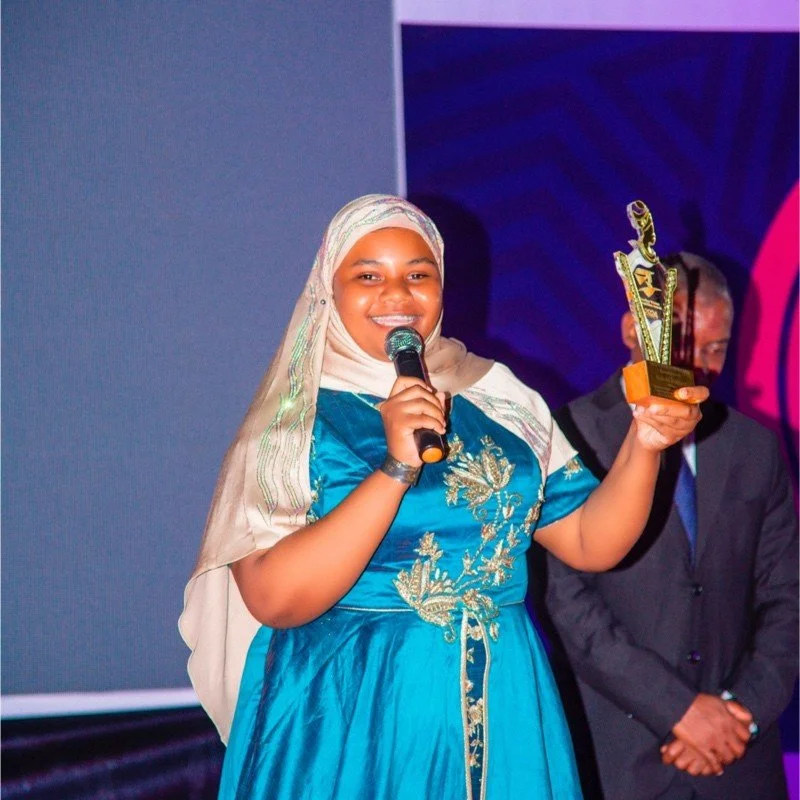
Nagla Abbas | Young feminist activist and Founder, Usawa Kwa Wote
Nagla Abbas (she/her) is a young feminist lawyer and a youth and girls’ rights advocate from Zanzibar, working on justice, peace, and gender equality across Africa. She holds an LLB in Law and Shariah from Zanzibar University and has over five years of experience in human rights and access to justice. She currently works with Save the Children International – Zanzibar as a Legal Officer at One Stop Centres, where she supports survivors of gender-based violence and violence against children through legal aid, psychosocial referrals, and case management.
She is the founder of Usawa Kwa Wote, a youth-led initiative (implemented as part of her role as a Women Deliver Emerging Leader from the West African cohort), which has reached over 3,000 adolescent girls with SRHR education, menstrual health support, leadership training, and economic empowerment programs.
Through her legal aid work, she provides legal support and community education on sexual violence, digital safety, and land rights. She also works with Assalam Community Foundation on programs and fundraising, and is actively engaged in peacebuilding efforts in Zanzibar and Pemba.
She is a member of the Tanzania Women, Peace and Security Coalition and serves as a Commonwealth Youth Peace Ambassador.